
Free Amazon FBA Calculator: How to Accurately Estimate Fees, Margins, and Net Profit
Launching a product on Amazon without knowing your exact numbers is the fastest way to burn through your hard-earned capital.
Many new and scaling sellers find a winning product idea, calculate a rough markup in their head, and start selling—only to realize later that Amazon referral fees, pick-and-pack charges, and monthly storage costs have silently eaten away all their profit margins.
If you want to build a sustainable and profitable e-commerce business, you need precision. That is where a reliable free Amazon FBA calculator becomes your most vital daily tool. In this complete guide, we will break down every single hidden cost of selling on Amazon and show you how to accurately calculate your net profit before spending a single dollar on inventory.
What Is an Amazon FBA Calculator?
An Amazon FBA (Fulfillment by Amazon) calculator is a specialized financial estimation tool designed for Amazon sellers. It takes critical product inputs—such as selling price, item dimensions, package weight, and cost of goods sold (COGS)—and automatically calculates:
- Amazon Referral Fees: Category-based marketplace commission (typically 8% to 15%).
- FBA Fulfillment Fees: Pick, pack, and weight-handling charges per unit.
- Inbound Shipping & Logistics: Landed cost of goods delivered to Amazon fulfillment centers.
- Estimated Monthly Inventory Storage: Warehouse cost calculated per cubic foot.
- Total Net Profit & ROI: Real dollar return and percentage margin on your investment.
Instead of manually navigating through Amazon's complex, frequently updated multi-tier fee tables, you can run realistic product simulations in seconds using the AMZEngine Free Amazon FBA Calculator.
Why Relying on Rough Estimates Destroys Amazon Profit Margins
A common trap for Amazon sellers is calculating profit using simple arithmetic:
Retail Price - Manufacturing Cost - Estimated Shipping = Profit (False assumption)
In reality, Amazon’s fee structure is dynamic and tiered. Here are the unexpected costs that catch unprepared sellers off guard:
1. The Dimensional Weight (Dim Weight) Shift
Amazon charges fulfillment fees based on either the actual unit weight or the dimensional weight—whichever is greater. If your product packaging is unnecessarily bulky, your FBA fulfillment fee tier can double overnight, wiping out a 20% margin.
2. Category-Specific Referral Fees
While the standard referral fee for most categories is 15%, certain categories (like Electronics accessories, Apparel, Fine Jewelry, or Grocery) have variable fee tiers, minimum referral fees, or lower percentages above specific price thresholds.
3. Peak Holiday Storage Spikes
From October through December, Amazon's base monthly inventory storage fees increase significantly. If your margins are paper-thin during Q1–Q3, Q4 storage costs can turn a profitable quarter into a net loss.
4. Low-Inventory and Return Processing Surcharges
Recent updates to Amazon’s fulfillment network penalize sellers carrying sub-optimal stock levels relative to historical sales volume. A modern FBA profit calculator helps you factor in return rates and logistical overhead accurately.
A Step-by-Step Breakdown of Amazon FBA Fees
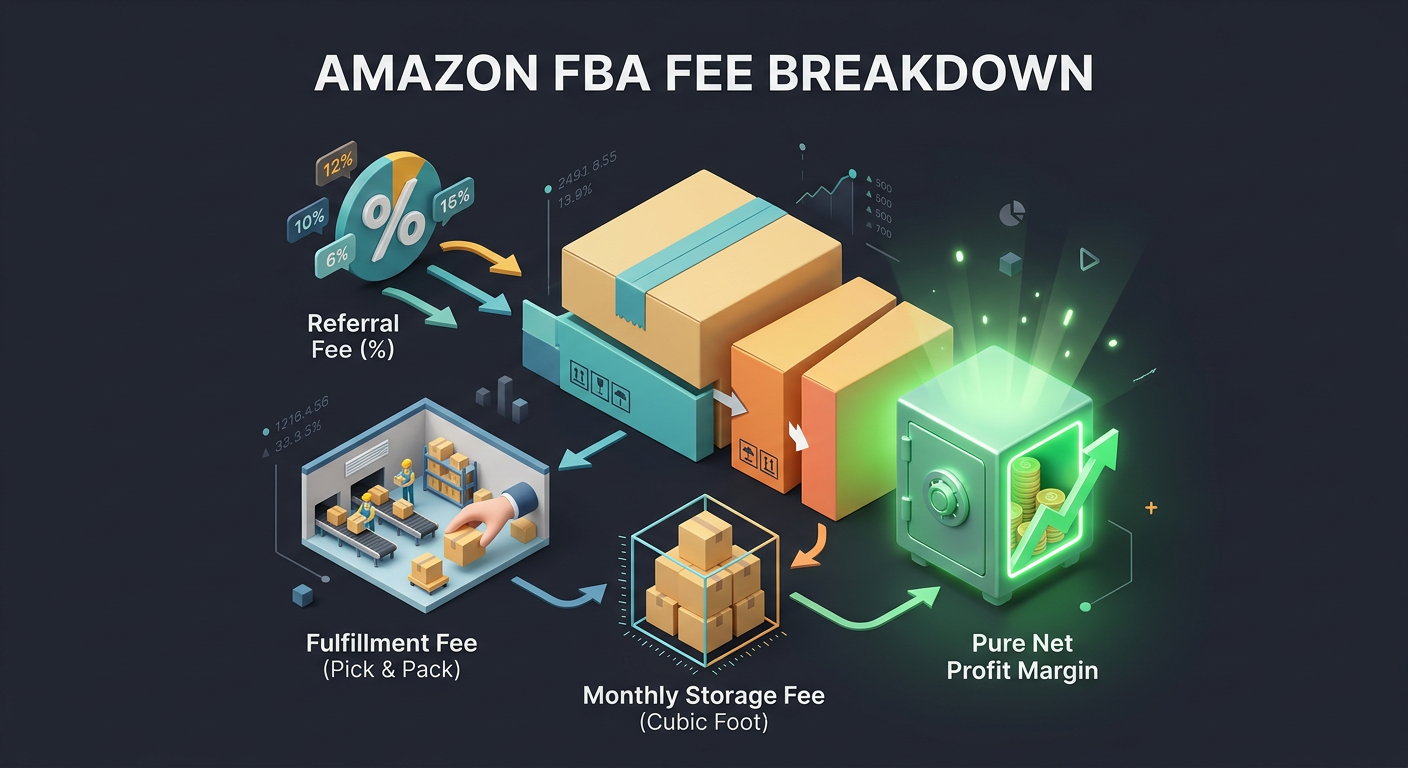
To understand the calculations happening behind our free tool, let's look at the core cost components:
- Cost of Goods Sold (COGS): Unit manufacturing cost directly from your supplier or factory, including custom packaging and barcode labeling.
- Inbound Freight & Customs: The cost to move your inventory from the factory floor directly into Amazon's fulfillment centers (DDP shipping cost per unit).
- Amazon Referral Fee: The commission Amazon charges for using its buyer traffic (typically 15%).
- FBA Fulfillment Fee: Covers picking from warehouse shelves, packing into boxes, tape, dunnage, and Prime 2-day shipping to the buyer.
- Storage Fees: Billed per cubic foot of warehouse space your inventory occupies across standard vs. oversize tiers.
Real-World Example: Calculating Real Net Margin
Scenario: Standard Kitchen Gadget Sourcing Analysis
- Retail Selling Price: $29.99
- Product Sourcing Cost (COGS): $6.00
- Inbound Freight (per unit): $2.00
- Amazon Referral Fee (15%): $4.50
- FBA Fulfillment Fee (Standard Size, 1.2 lbs): $4.75
- Estimated Storage & Misc (per unit): $0.74
Try the Free AMZEngine FBA Calculator Today
Plug in your product dimensions and sourcing costs to get instant, accurate profit margins in seconds.
Open Free FBA Calculator →How to Use the AMZEngine Free Amazon FBA Calculator
We built the AMZEngine Free Amazon FBA Calculator to remove the guesswork and give you instant financial clarity. Here is how to use it in 3 quick steps:
- Input Product Details & Selling Price: Enter your planned retail price or your competitor's listing price. Select your product category so the tool applies the exact referral fee percentage.
- Add Dimensions & Unit Costs: Enter your package dimensions (length, width, height) and unit weight. Fill in your manufacturing cost (COGS) and estimated shipping-to-Amazon freight cost.
- Analyze Instant Profit Margins & ROI: The calculator instantly renders your fulfillment tier, Amazon deductions, net profit per unit sold, and your minimum break-even price.
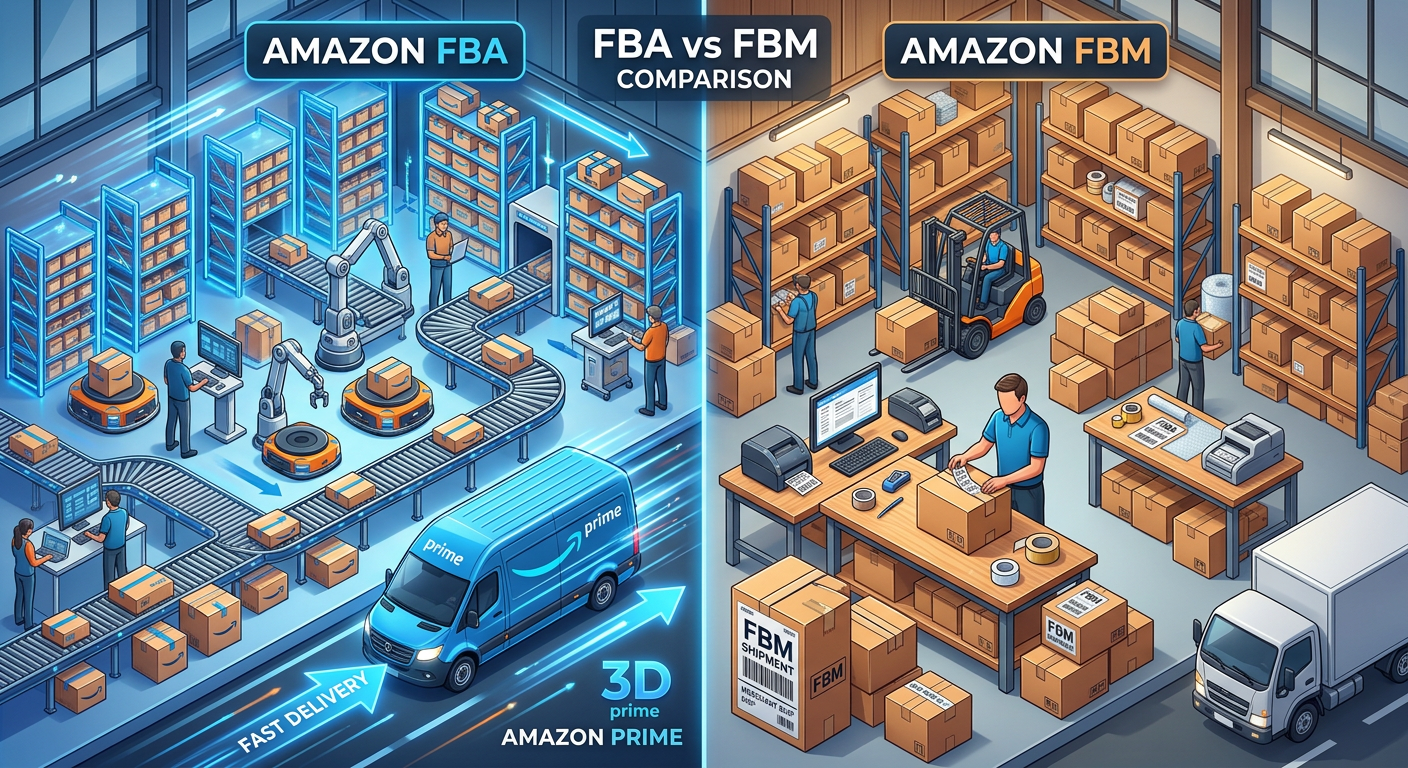
FBA vs. FBM: Which Fulfillment Method Yields Higher Profit?
| Feature / Metric | Fulfillment by Amazon (FBA) | Fulfillment by Merchant (FBM) |
|---|---|---|
| Prime Badge | Instant Prime eligibility (Boosts Buy Box win rate) | Requires Seller Fulfilled Prime qualification |
| Logistics Handling | Amazon handles 24/7 pick, pack, shipping, and returns | You handle packing, warehouse storage, and carrier contracts |
| Fee Structure | Fixed FBA fee per unit + monthly storage fees | Carrier postage + shipping supplies + internal labor |
| Best Suited For | Fast-moving, standard-size, lightweight products | Heavy, oversized items, fragile goods, or custom items |
4 Crucial Metrics Every Amazon Seller Must Watch
- Target a Minimum 30% Net Profit Margin: After all FBA fees and product costs are deducted, your organic margin should ideally be 30% or higher. This leaves a 10–15% buffer for Amazon PPC ads while remaining profitable.
- Aim for Over 100% ROI: A 100%+ Return on Investment means that if you invest $5,000 into inventory, you receive your initial $5,000 back plus an additional $5,000 in gross profit.
- Know Your Break-Even Price: Always check the exact dollar figure where your profit equals $0.00. This is your baseline floor during price wars or aggressive clearance sales.
- Watch Package Packaging Reductions: Shaving just 0.5 inches off a carton or reducing box weight by 2 ounces can drop your product from "Large Standard" to "Small Standard" tier, saving you thousands of dollars per batch.
Frequently Asked Questions (FAQs)
Is the AMZEngine Amazon FBA Calculator completely free?
Yes. The AMZEngine FBA Calculator is 100% free to use with no subscription, credit card, or sign-up required. You can run unlimited product calculations daily.
How often do Amazon FBA fees change?
Amazon typically reviews and updates its fulfillment fee structures annually (often with adjustments in Q1 and holiday peak rates in Q4). Our calculator keeps up with the latest fee schedules so your estimates remain dependable.
Does the calculator account for Amazon PPC advertising costs?
The calculator provides your pure net product margin first. You can then budget your Target ACoS (Advertising Cost of Sales) against that margin to see your true net take-home profit.
What is a good profit margin for an Amazon FBA product?
A net profit margin between 25% and 35% is considered healthy for private label and wholesale products. Margins above 40% are exceptional and provide strong resilience against rising ad costs.
Final Thoughts: Validate Before You Source
The difference between a 6-figure Amazon seller and a struggling store owner almost always comes down to unit economics. Never commit to inventory based on instinct or rough approximations.
Take 60 seconds to plug your numbers into our Free Amazon FBA Calculator on AMZEngine and make confident, data-backed sourcing decisions today.